Reading the aurora forecast
An aurora forecast tells you how busy the sky above the clouds is likely to be. It says nothing about whether you will see through those clouds, and that second question decides most nights in Fairbanks. Learn to read both and you will book more wisely, though no number promises a show.
What an aurora forecast measures
The aurora is driven by the solar wind, the flow of charged particles streaming out from the sun. When that flow hits harder or carries the right kind of magnetic field, it shakes the Earth's own field and lights up the ring around the pole known as the auroral oval. Most forecasts boil this down to the Kp index, a scale from 0 to 9 that measures how disturbed the magnetic field is. Zero means calm, and 9 means a storm of the kind that puts aurora over places that rarely see it.
For Fairbanks the scale reads differently than it does for Europe or the lower 48. The town lies under or near the oval, so a modest Kp, a 2 or 3, is often enough for a show overhead on a clear night. A high reading helps, but it also pushes the oval south, and in a big storm the brightest light may sit over the southern sky rather than straight above you. A low number on its own is never a reason to stay in.
The Geophysical Institute forecast
The Geophysical Institute at the University of Alaska Fairbanks has studied the aurora for decades and publishes a daily forecast. It shows where the oval is expected to sit and how active it should be. Read it as a weather outlook for the upper atmosphere. It gets less reliable the further ahead it looks, and an outlook for next week is closer to a guess than a plan.
One longer pattern makes a loose hint. The sun turns roughly once every 27 days, and the same active region or gap in its outer atmosphere can face the Earth again a rotation later. A lively night may therefore come round again about four weeks on. Take that as a nudge when choosing a trip, nothing firmer.
Solar wind speed and Bz
The daily forecast covers the broad picture. For the next hour, guides watch live data from spacecraft that sit between the sun and the Earth and measure the solar wind before it arrives. Two readings matter most. The first is speed, because a faster wind tends to carry more energy into the oval. The second is Bz, the north-south direction of the magnetic field the wind brings with it. When Bz points south, shown as a negative number, the Earth's field lets more of that energy in, and if it holds south for a while the sky often brightens soon after.
That warning is short, usually an hour or less. It is why a chase guide may pull into a dark pullout before anything shows, and why a quiet sky at 10 pm says little about 1 am. Kp, by comparison, is worked out over three-hour blocks and lags behind what is happening now.
Cloud maps matter more
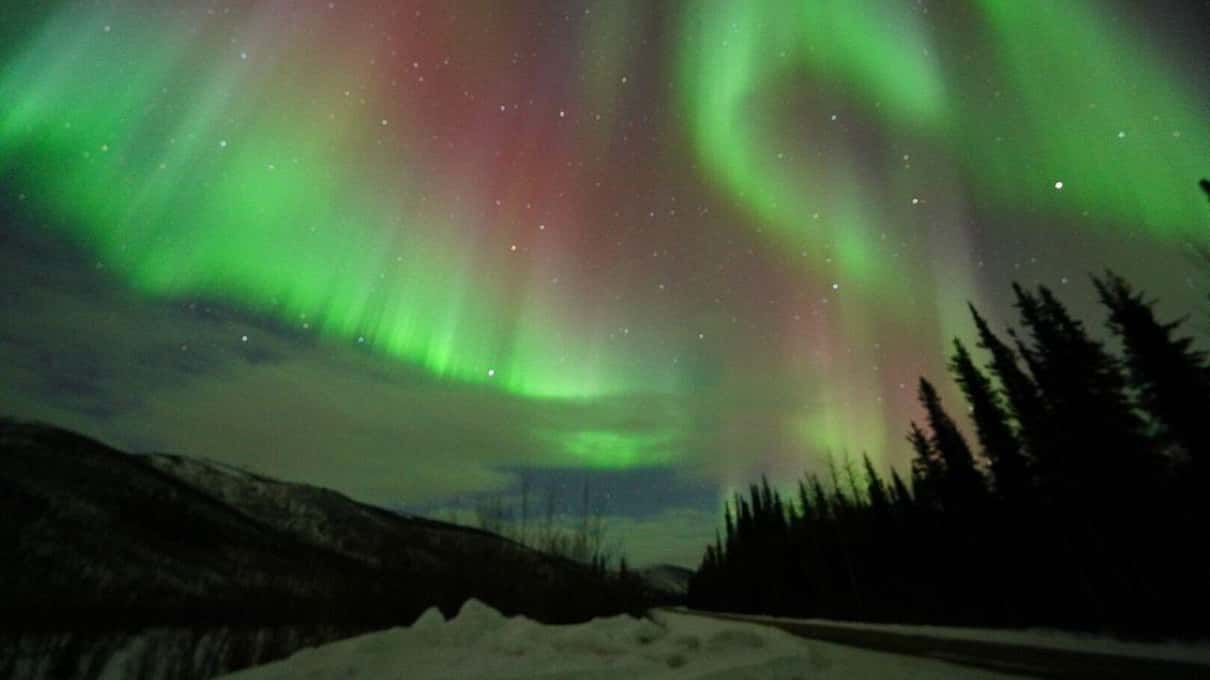
The forecast describes the sky above the weather, and the weather decides whether you see any of it. A strong night under solid cloud shows nothing, while a quiet night under a clear sky can still bring a green arc across the north. In Interior Alaska clouds come and go by valley and ridge, so a regional cloud cover forecast and live satellite cloud images tell you more about where to stand than any aurora number. If you check one thing on the afternoon of your tour, make it the cloud map. The moon and the time of year shape the picture too, and our season guide covers both.
How the guides decide where to go
Arctic Night Tours' guides weigh the Kp outlook and live solar wind data against the cloud maps, then drive to wherever the sky looks clearest, more than 200 miles (320 km) on some nights. SkyChase has an "auro-meteorologist" forecasting alongside its guides and moves the vans to match. On the Arctic Circle day, Midnight Sky Adventures times its aurora stops on the drive home by real-time data. The glass house cannot move and generally runs whatever the weather, so reading the forecast yourself matters more there. Chase or cabin sets the two styles side by side, and hunting the lights on your own explains what you take on without a guide.
A forecaster on the team, and a second try
SkyChase pairs its guides with an auro-meteorologist and gives you a refund or another night if no lights appear. About five hours with a campfire meal, from ~$335.
Using the forecast to book
All six tours on our home page can be cancelled for free until 24 hours before they start, and that window is where the forecast earns its keep. Book early in your stay, then check the outlook and the cloud forecast the day before, while cancelling still costs nothing. A clear sky with a modest Kp is a reason to go. Solid cloud over the whole region is a reason to move a fixed-spot night like the glass house or Chena, while a chase may still find a gap. Outlooks a week or more ahead are too vague to plan around, so do not pick travel dates by them.
The trick does not work on every tour. The Alaska Wild Lights Chena tour at ~$275 and the same company's Arctic Circle trip at ~$363 are non-refundable. The dog-sled night, which runs only from December to March, is non-refundable too if you book it through Viator. The price guide shows which tours leave you room to react to the sky.
What no forecast can tell you
No number promises the lights. Displays build and fade within minutes. A forecast storm can fizzle while a quiet night surprises everyone at 2 am. Your eyes also see less than the readings suggest, since faint aurora often looks grey-white until a camera picks up the green; our photography guide explains why. A forecast is most useful for deciding when to be outside, and nothing replaces having several nights to try. What to wear deals with staying out there long enough.